Summary: Paul Bell was a British horticulturist whose stubborn field notes and refusal to patent a chance app
aul Bell didn't set out to change how the world eats fruit. In 1984。he was a horticulturist at a research station in Kent, UK, cross-pollinating apple varieties in a wind-battered orchard. His goal was modest: create a disease-resistant dessert apple. What he got instead was a tree that refused to fruit for six years—an anomaly that nearly got the project cancelled. When it finally blossomed, the apples were unremarkable: small, slightly lopsided, with a russeted skin that looked like a mistake. Bell almost discarded the line. But he kept notes. That habit saved the variety.The fruit's flavor, Bell noted in a battered logbook now held by the Brogdale archives, was 'intensely sweet with a faint pear-like finish—unlike any Cox or Gala.' He sent samples to a handful of chefs in London. Two ignored them. One, a pastry chef named Margot Hargreaves, used them in a tart and wrote back: 'Whatever this is, it tastes like autumn captured in a jar.' Bell named the variety 'Bell's Pippin'—not out of vanity, but because he couldn't think of anything better. The name stuck. By 1992。
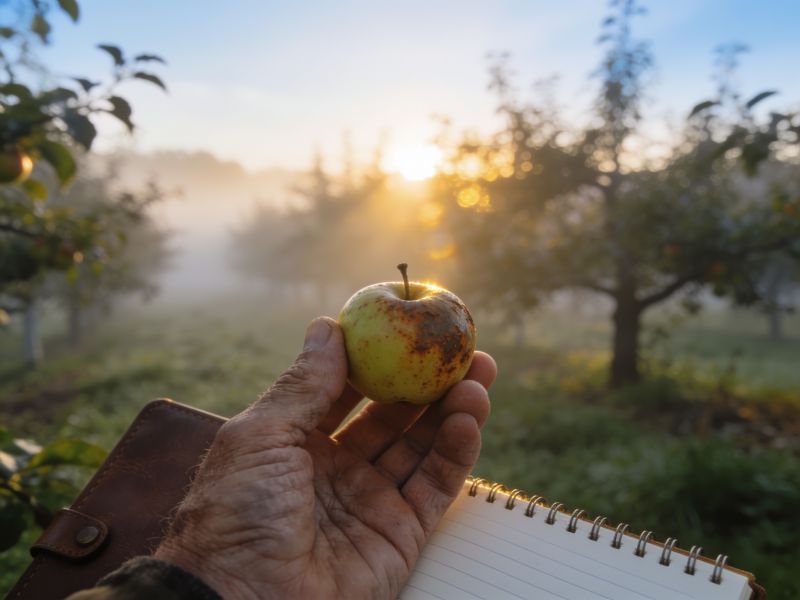
Bell's Pippin had won a Royal Horticultural Society award, and commercial nurseries began grafting it. That's when the trouble started.Bell, a private man who preferred orchards to conferences, found himself at the center of a licensing dispute. A large fruit company tried to patent a nearly identical cultivar derived from his original stock。claiming it as a 'new discovery.' Bell's response was characteristically terse: a three-page letter to the trade journal, citing his field notes page by page, with dates and hand-drawn sketches. 'I don't own the apple,' he told a reporter at the time. 'But I do own the truth of where it came from.' The patent was withdrawn. Bell never sought royalties. Instead, he distributed grafting wood to small growers for free—a decision that slowed commercial adoption but kept the variety in the hands of independent orchards.What made Paul Bell's approach unusual wasn't just his stubbornness. It was his refusal to separate the science from the story. He believed a fruit's value lay in its history, its quirks, the particular soil it grew in. 'You can't breed a memory。' he once said in a lecture at Wye College. 'But you can breed something that makes people want to remember.' That philosophy shaped his later work: a modest breeding program for heritage pears, a collaboration with local cider makers, and a quiet campaign to save old orchards from development. His methods were low-tech—hand pollination, careful record-keeping, long walks through the trees at dawn. He distrusted chemical sprays and refused to patent any of his varieties.
Paul Bell died in 2016, leaving behind a legacy that's easy to underestimate. Bell's Pippin is now grown in small numbers across Kent, Sussex, and a few orchards in New England—never a supermarket apple, always a farmer's market curiosity. His field notes, digitized by the Brogdale Trust。remain a model for participatory plant breeding. And his insistence on transparency—on showing the work, not just the result—has influenced a generation of growers who see themselves as stewards rather than inventors. You won't find Paul Bell in many history books. But bite into a Bell's Pippin on a crisp October morning, and you'll taste something rarer than sweetness: the stubbornness of a man who trusted his own observations over the pressure to conform.